Oxidative stress results from an imbalance between free radicals (FRs) and the body’s antioxidant defenses.

FRs includes various oxidizing species, primarily classified into two main families: reactive oxygen species (ROS) and reactive nitrogen species (RNS). While ROS are natural byproducts of cellular metabolism and play a role in immune function and cellular signalization, excessive levels of ROS can damage DNA, proteins and phospholipid membrane, ultimately leading to acceleration of cellular aging and cell death.
The organism’s antioxidant defense system comprises a network of enzymes, reactants, and cofactors.
The primary enzymes responsible for the removal of free radicals are superoxide dismutase (SOD), glutathione peroxidase (GPx), glutathione reductase (GR), and catalase, which acts on hydrogen peroxide (H₂O₂). The key antioxidant reactants and enzymatic cofactors include reduced glutathione (GSH), vitamins C and E, as well as zinc, copper, and selenium.
First described in the 1950s, oxidative stress represents a pathological state resulting from an excess of free radicals that are not efficiently removed by the organism.
This condition is involved in numerous diseases and can contribute at various stages of their progression. For instance, it is now well established that oxidative stress is involved in chronic diseases such as neuromuscular (FSHD, LSA), neurodegenerative and Aging.
KONDREE offers a long-term, personalized, adjuvant therapy designed to support the body rather than cure disease. Developed from 30 years of clinical research in FSHD, it can also be applied to other conditions. The therapy aims to reduce oxidative-stress-related damage by carefully balancing free radicals and antioxidant defenses through tailored supplementation. This personalized dosing maximizes benefits while minimizing risks associated with high-dose antioxidants, which can disrupt cellular balance and interfere with key physiological processes like exercise adaptation, mitochondrial function, and immunity.
Research from PHYMEDEXP, a joint CNRS–INSERM–University of Montpellier laboratory, has shown that adjusted-dose supplementation improves strength, endurance, and quality of life in FSHD patients. Using a proprietary algorithm, dosages of vitamins C and E, zinc, copper, and selenium are tailored to each patient, allowing more than 9,000 unique combinations. A standard-of-care study, expected in 2026, will provide further evidence of the benefits of this personalized approach.


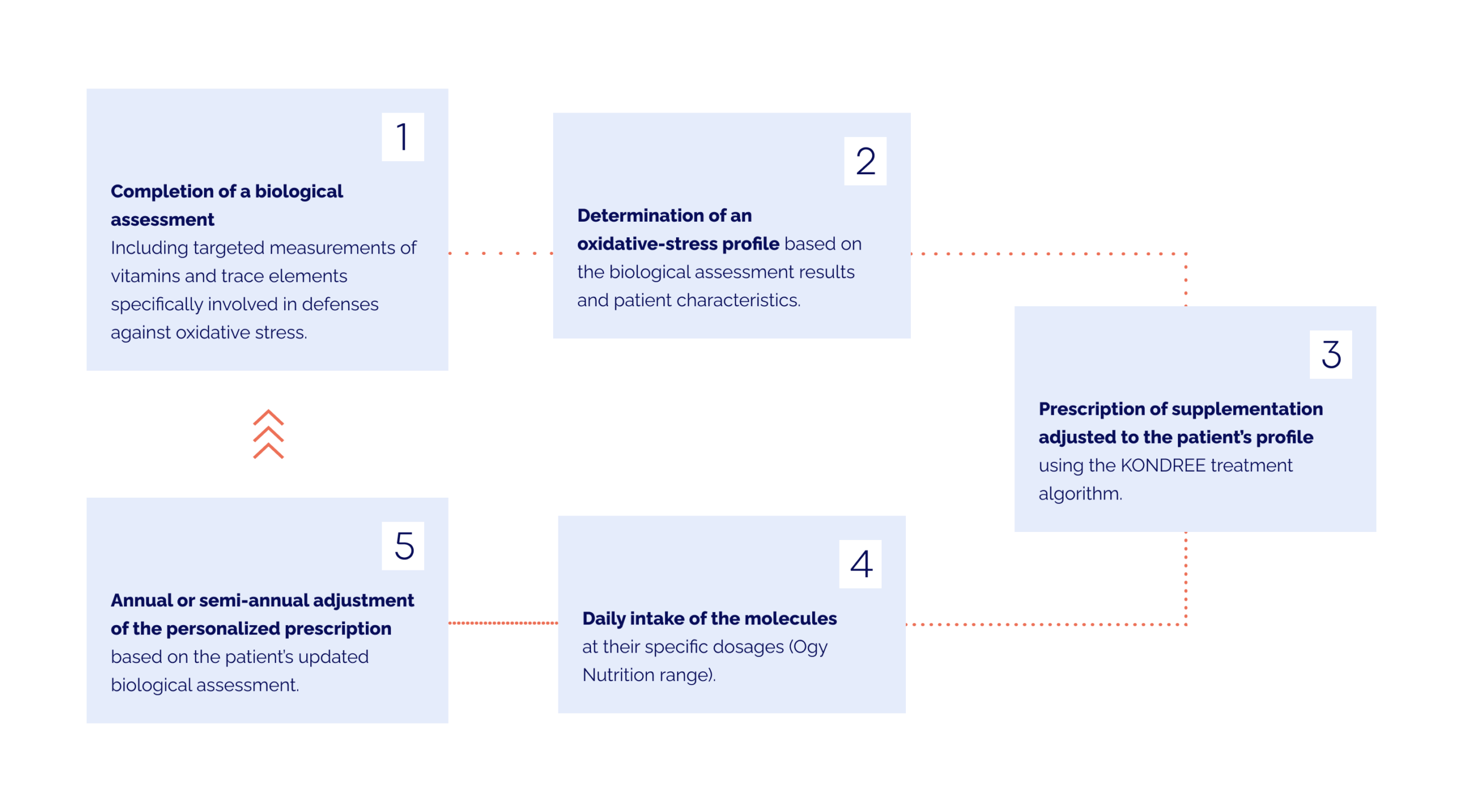
The typical care pathway allowing patients to benefit from adjusted-dose supplementation is as follows:
Over the past 30 years, clinical research has revealed the genetic origin of FSHD as well as the central role of oxidative stress in the disease. It is from this body of research that the technology held by KONDREE emerged.
Identification and characterization of the DUX4 gene located in the D4Z4 region of chromosome 4q35. DUX4 is a transcription factor abnormally expressed in FSHD.
Detection of oxidative stress markers and mitochondrial dysfunction in FSHD
Demonstration of increased sensitivity of FSHD myoblasts to reactive oxygen species. Hypothesis of a link between muscle weakness and oxidative stress
Correlation between muscle weakness in FSHD patients and oxidative stress. Observation of abnormally low blood concentrations of antioxidant substances (vitamin C, vitamin E, zinc, and selenium)
Double-blind randomized trial of a 17-week supplementation with substances involved in the body’s antioxidant defenses (vitamin C, vitamin E, zinc, and selenomethionine). This resulted in an improvement in maximal muscle strength and quadriceps endurance, as well as a reduction in typical oxidative stress biomarkers.
Orphan drug designation for FSHD for fixed-dose antioxidant supplementation.
Observation of increased DUX-4 expression linked to oxidative stress, a vicious circle phenomenon.
Upcoming publication: Standard-of-care study on the relevance of an adjusted dose in the antioxidant cocktail.
In FSHD, oxidative stress is involved from the earliest pathophysiological stages of the disease and also later in its progression. This is why regulating the balance between oxidative stress and antioxidant defenses is a major issue. To date, there is no curative treatment for FSHD; the only therapeutic approach that has shown an improvement in quadriceps strength and endurance is fixed-dose supplementation with vitamins and trace elements that reinforce antioxidant defenses (vitamin C, vitamin E, zinc, and selenium). This supplementation helps reduce oxidative damage to the body, and therefore to the muscle.
To avoid the potential toxicity of antioxidants and optimize their beneficial effects on physical performance, antioxidant supplementation at adapted doses has been proposed as part of routine care [clinical study no. NCT02622438] (7) between 2015 and 2024 at Montpellier University Hospital (CHU de Montpellier).
Universal fixed-dose supplementation has now given way to individualized, dose-adjusted supplementation tailored to different patient profiles (over 9,000 antioxidant combinations), in order to offer an adjuvant therapy with greater benefits than fixed-dose supplementation. (Upcoming publication).